What’s it doing? A convergence of thought.

Something strange is happening to original thinking. Engineers who’ve never met each other are arriving at eerily similar ideas within days of each other. Everyone is using the same tools to “think” now, and those tools are shaping thought in ways we don’t fully appreciate. When millions of people ask similar questions to the same AI, they get similar answers, and over time those answers start to feel like original ideas. Our stack of $20/month subscriptions are quietly commoditizing thought itself.

What’s unsettling is how fast this happened and how few people noticed. Everyone is focused on capability gains, on shipping faster, on keeping up with the earthquake.
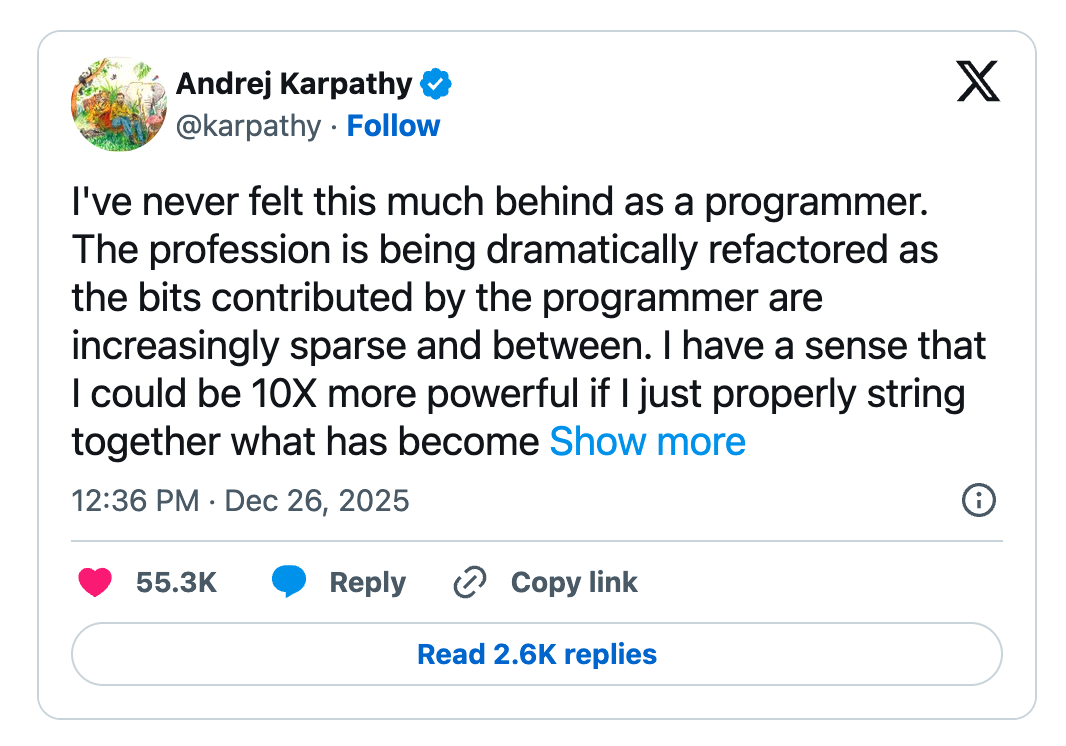
Meanwhile a convergence of thought occurred at an astonishing rate. And, depending on who is building + running the models, convergence of thought sits uncomfortably close to control of thought. That’s not a conspiracy theory, just an observation about what happens when a few providers shape how millions of people frame problems and generate solutions.

What gets suggested to users is what they’ll pick, right? That in and of itself is a source of bias. This happened to me recently:

Continue reading “What’s it doing? A convergence of thought.”
Lethain has finally weighed in on AI adoption

Will Larson published a post last week on facilitating AI adoption at Imprint. It’s one of the most practical things I’ve read on the topic. It’s that way because it speaks from hands-on experience. If you’re an engineering leader trying to figure out where to start, read, then do.

The post maps to a lot of what I’ve learned and witnessed after 16 years at Red Hat. Some of it extends what I’m seeing or sits in tension with the research I’ve been tracking.

Here’s my attempt to sort through it.

In agreement

Build your intuition first.

Will spent 2-10 hours on bounded projects. He calls this “prework.” It’s the most underrated advice in the post. At a recent team f2f, I was upfront with my peers (SWE directors): you yourselves have to spend multiple weekends discovering what your job needs to become. The post echo’d that “In an era of crushing optics, senior leaders immersing themselves in the details is one of our few defenses.”

If you skipped this step throw a 180 – it’s not too late. Folks read about agents, attend demos, approve budgets. Then they’re surprised when adoption stalls. You can’t lead a transformation you don’t understand first-hand.

Continue reading “Lethain has finally weighed in on AI adoption”

6 thoughts on my first AI.engineer CODE + AI Native DevCon

AI.engineer was exceptional. We should crowd-source somehow keeping it the way it is. Larger conferences typically operate at a higher altitude and there is a useful niche for smaller technical events. Recordings here.

I wanted to reflect on some common trends across talks from Stanford, McKinsey, Capital One, Every, Tessl, Human Layer, and others.

But first, 80+ people starred the repo for AgentReady. I bootstrapped that in real-time during AIE.

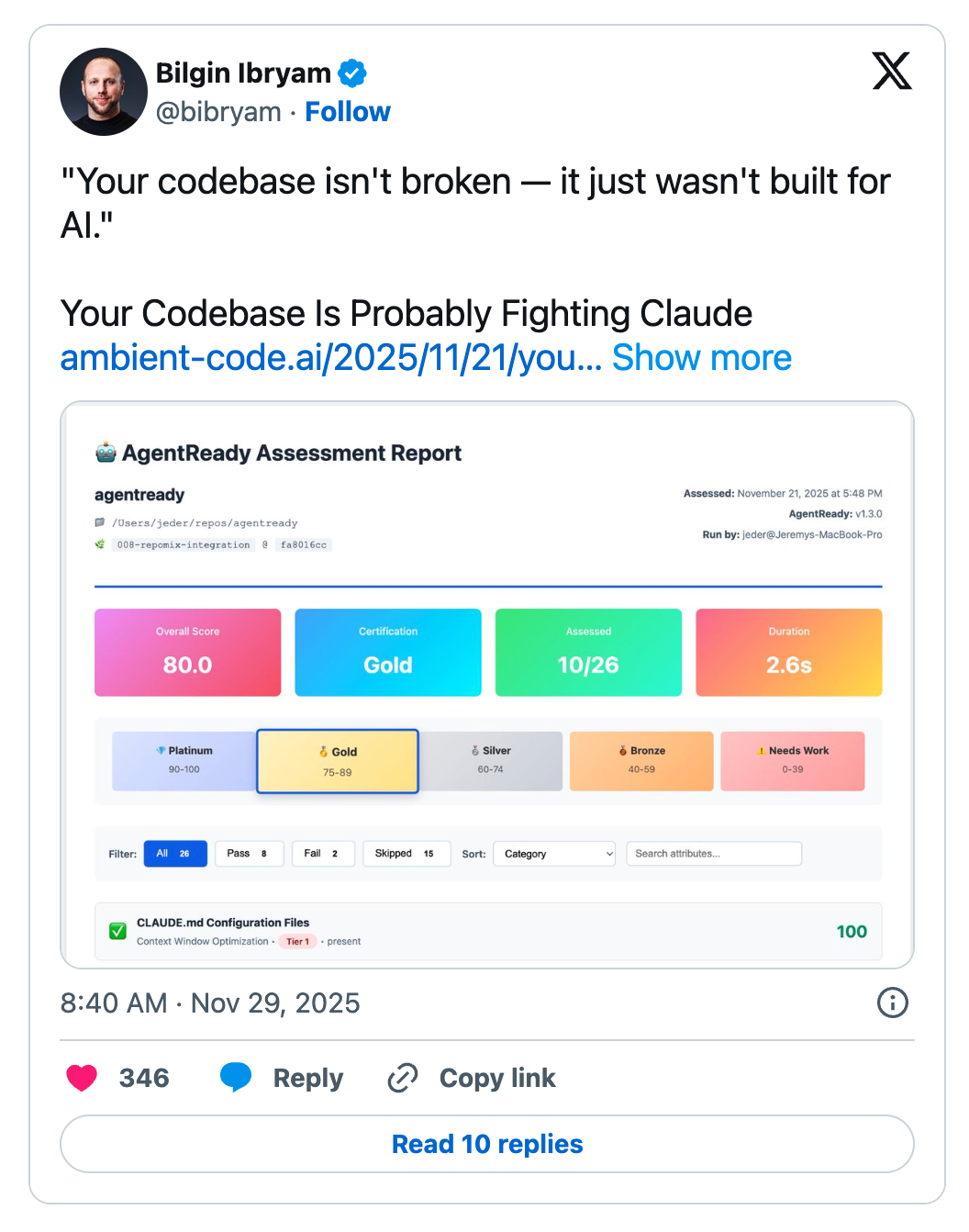
Since then, I found this tweet acknowledging the need for measuring codebases against up-to-the-minute guidance on what makes a codebase “Agent Ready”.

I’ve since added an align verb that can be used to level-set your repo interactively, or run it headless/CI to prevent drift or implement new techniques as things evolve.

To this point I hadn’t seen a measurement angle on assessing brownfield codebases for introducing agents. People are still figuring it out and it had only just gotten started being discussed in the abstract. Capital One had it nailed during their talk though.

So – we can measure things now, at least relatively. Is it accurate? Claude thinks so. This is an area I would love Issues, PRs or even just discussions on social media.

On to my conference take-aways:

Continue reading “6 thoughts on my first AI.engineer CODE + AI Native DevCon”