weArIng a different hat (still Red)

Earlier in August 2023 I changed roles within Red Hat. My new role is “Chief AI/ML Platform Strategist”, and organizationally is part of Red Hat’s OpenShift AI product group.

I’d been in my previous role for ~5 years, and celebrated my 14th anniversary at Red Hat last month 🫶 . My previous team (Red Hat Service Delivery) afforded me endless technical challenges, opportunities to launch new services, present, help define technical strategy and build cross-org engineering teams to support that strategy, from the ground up. Equally important to me was the opportunity to mentor as many Red Hatters as I possibly could.

And now, on to the next chapter. Red Hat’s CEO Matt Hicks did an interview recently that describes how Red Hat will participate in the AI/ML ecosystem as a platform company, specializing in machine learning operations (MLOps). My role involves working with engineering and product leaders to devise a strategy that will deliver a sustainable open source, enterprise software business around artificial intelligence and machine learning.

Continue reading “weArIng a different hat (still Red)”
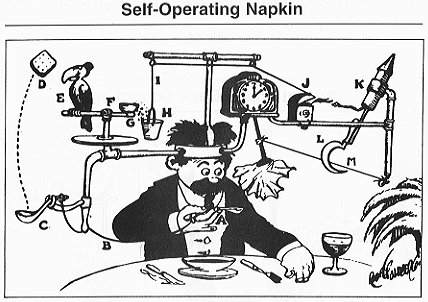
If you’re totally comfortable to launch, you’ve waited too long.

It’s both exciting and nerve-wracking to develop highly visible production service platforms. Exciting, in that the ideation phase of creating a differentiated offering inspires “creatives” in the software engineering space to do their best work. Nerve-wracking, in that knowing the details of implementation, and what hit the editing room floor during planning/prioritization exercises, carries with it a certain sense of responsibility — especially if you end up being caught-out on any of those areas as “real usage” begins.

There was a fantastic paper written last year on the topic of creativity in software engineering. Highly encouraged reading, especially for software engineering managers, technical team leads, those involved in hiring/promotions and so forth.

In order to solve today’s complex problems in the world of software development, technical knowledge is no longer enough. Previous studies investigating and identifying nontechnical skills of software engineers show that creative skills also play an important role in tackling difficult problems.

Exploring the Role of Creativity in Software Engineering, Jan 2021, https://arxiv.org/pdf/2101.00837.pdf

For this blog, I’ll focus on the experience the team I led went through during the bring-up of a highly visible service launch scheduled for March, 2021 called Red Hat OpenShift on AWS (ROSA).

The ROSA service was a first-of-its-kind, first-party offering (transacted through Amazon) that would be added to the AWS console. That set the high bar for the team to deliver on what the business partnership between Red Hat and AWS had negotiated. Shortly thereafter additional first party services from partners were added to AWS console (Grafana has one at least). But indeed ROSA was the first 🙂

Continue reading “If you’re totally comfortable to launch, you’ve waited too long.”

What it’s like to be “how constrained” and becoming a free thinker

I think it’s most folks (engineers especially) default approach, when being introduced to a new system, product or idea, to immediately want to understand “how” something works. This blog is to specifically challenge that default, turn it around, and pose that we default to “why” something works. Why it has to exist, and why it is the way it is.

Continue reading “What it’s like to be “how constrained” and becoming a free thinker”

Lessons learned while bootstrapping new $things

During my career at Red Hat, I’ve had the great pleasure of being a go-to person to bootstrap $things. After a good amount of repetitions, I’ve arrived at a bit of a blueprint on how to do it. Each go at it becoming more and more refined and incorporating lessons learned as each $thing presents its own nuances.

As an engineer exploring ways to bootstrap $things, Simon Sinek’s book Start with Why deeply resonated with me. I began looking for frameworks that let me capture “why” in a way that has unyielding precision, and found the Patrick Lencioni’s Six Critical Questions section in his book The Advantage.

I’ve now used this format several times and am continually impressed by how durable it is. If you can capture the essence of the new $thing in this format, you can look back on it even years in the future, and your intent remains unambiguous.

Continue reading “Lessons learned while bootstrapping new $things”